Opening speech by Ruby Hoette | School year 2026-2027 Sandberg
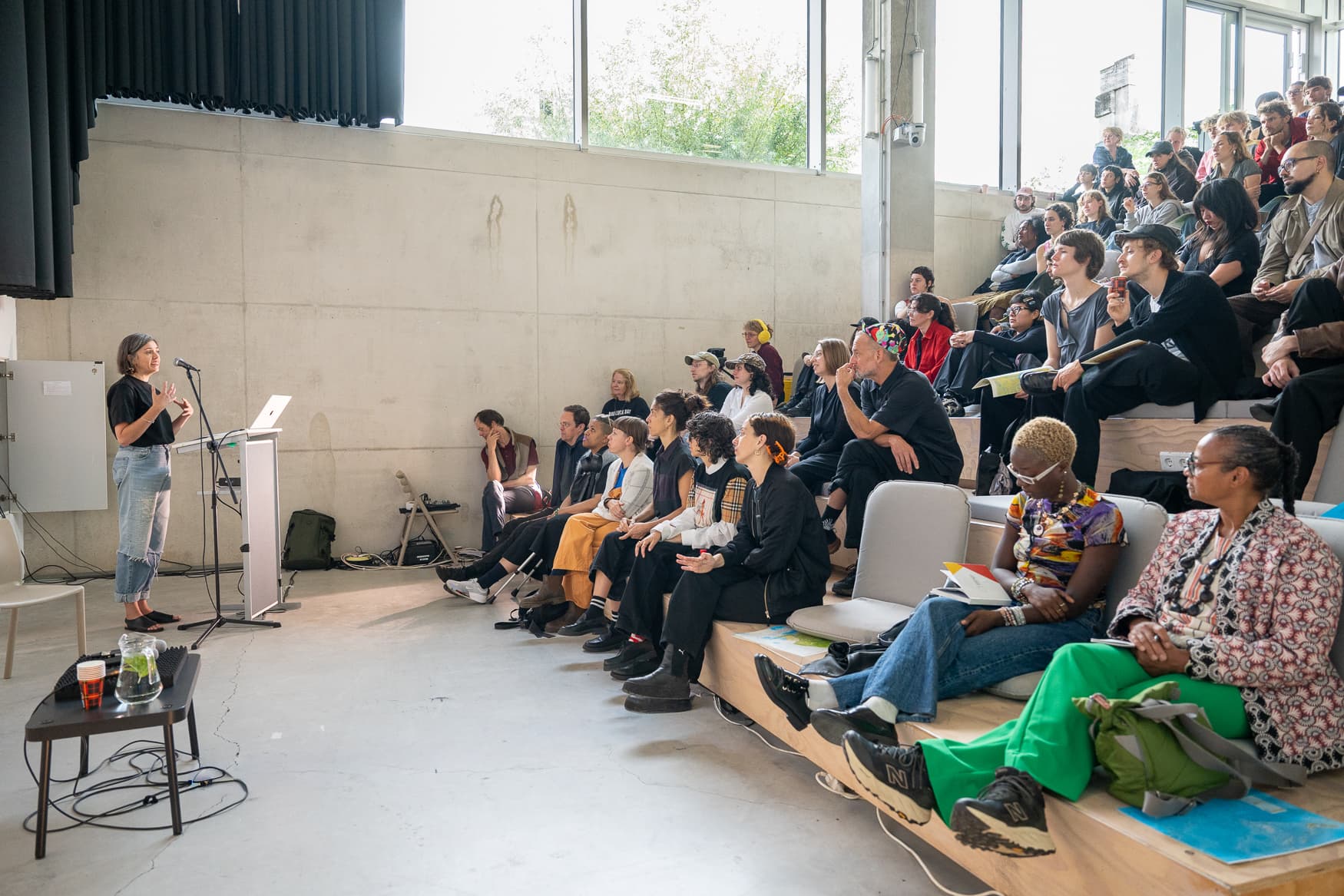
Sandberg Institute's director Ruby Hoette welcomed our new students with an opening speech during the Opening Day of the Year.
"Hello and a very warm welcome to the Opening of the Sandberg Year 2026.
As director of the Sandberg Instituut, I’m very happy and honoured to begin this year with you. As is tradition, each year the director offers a few words of introduction. My hope is that after today our interactions will become much more conversational, but for now I’d like to share some unfinished thoughts to mark the beginning of your time at Sandberg and the two years ahead.
Last year, standing here, I spoke about stitching and speculation. About the stitch as a very small material gesture: one that connects things without necessarily making them the same. A stitch can hold something together, repair it or reinforce it, but it is also provisional. I was thinking then about the stitch as a way of understanding what we do here: making connections under uncertain conditions and assembling things into new forms.
This year I have found myself thinking about another quality of the stitch: a stitch is also a line. Lines connect one point to another. They can give us direction, become paths and borders, or describe a movement. We use them to make maps. We follow them, cross them, resist them, are told to stay within them, or sometimes find ourselves outside them.
Thinking about lines and paths brings me to a question that perhaps accompanies any beginning: How do we find our way?
You are all holding a page from a map. More precisely, a page from a Reader’s Digest Atlas of the World, published in 1989. [1]
Until yesterday, all these pages were bound together. I have taken the atlas apart to give each of you a fragment. The atlas made them belong together. Separate sheets were printed, folded and physically bound into a particular sequence, producing something we recognise as the world. Now that the binding has been removed, each sheet contains two quite different pieces of that world—places brought together not necessarily by geography, but by the material construction of the book.
The page you are holding is therefore relational. For now, just keep it with you, knowing that somewhere in this room, someone is holding the page that used to sit beside yours.
Allow me to share some more fragments that, like the pages of the atlas, have been removed from their original contexts.
The writer and scholar Sara Ahmed begins her book Queer Phenomenology with an introduction called “Find Your Way,” in which she asks what it means to be orientated:
“How do we begin to know or to feel where we are, or even where we are going, by lining ourselves up with the features of the grounds we inhabit, the sky that surrounds us, or the imaginary lines that cut through maps? How do we know which way to turn to reach our destination?” [2]
For Ahmed, being orientated means having our bearings. We recognise certain things around us, and they tell us something about where we are. They become landmarks, familiar signs or anchoring points from which we understand our relationship to what surrounds us.
Ahmed also emphasises that orientation is bodily. We orient ourselves from the “here” of the body: through how we inhabit a space, what is within reach, what we turn toward and how we move. We don’t simply look at the world from outside it; we find our way by moving through it. Sometimes you understand something through doing long before you are able to explain it.
This feels particularly important here at Sandberg, where so much knowledge is produced in exactly this way. Through making, handling materials, trying something and encountering its resistance. Through bodies working in spaces, alongside other bodies. Through attention, experience and repetition.
Ahmed refers to the familiar phrase “a path well trodden.” A path isn’t first drawn and then followed. It emerges because feet repeatedly tread the same ground. Bodies make the line through movement, and the ground itself is changed by their passing. Once that line becomes visible, other bodies are more likely to follow it because the path appears more clearly. She describes the resulting paradox beautifully:
“Lines are both created by being followed and are followed by being created.” [3]
So movement leaves traces. These traces form around us, and those forms in turn shape where it becomes easier (or harder) for us to go. The paths that direct us often depend upon routes already taken, conventions followed, choices made again and again.
All of us arrive here today with well-trodden paths already beneath our feet. There are histories of art and design, disciplinary conventions and ideas about what an artist, designer, writer, architect, researcher or director does. There are institutional structures and expectations. There may already be ideas about success, progress and where you imagine you should be in two years’ time. But you will also follow and make new paths through what you do here. Through your practices, materials and methods; through the spaces you inhabit; through who you work with and what you repeatedly give your attention to.
Some of the existing paths contain important knowledge. They have been made by people moving before us and can help us find our way. But others have become so familiar that we stop noticing that they are paths at all. We mistake them for the ground itself.
And this brings us back to the page of the atlas that you are holding in your hands. Somewhere on it there will be lines: longitude and latitude, borders, roads, coastlines, perhaps an equator. Some describe physical features; others exist because people and institutions have decided to draw them there.
Ahmed writes about one of the most familiar of these lines, the prime meridian:
“The prime meridian as the line that divides the West from the East as ‘two sides’ of the globe is imagined…” [4]
What we call East is therefore only east from a particular zero point. As Ahmed writes, it “acquires its direction only by taking a certain point of view as given.” [4]
Maps are powerful instruments for claiming and controlling territory. Colonial maps rename places, draw borders across lands and relations, and translate land into something that can be measured, divided, owned and governed. The lines on the page you are holding are not simply descriptive. Maps don’t only represent worlds; they participate in producing them. Borders are imposed, enforced, refused and reclaimed. A line that appears thin and unremarkable on paper can correspond to profound violence on the ground.
What we use to orient ourselves is therefore always political: which map are we using, from where was it drawn, what does it make visible or erase, and whose viewpoint does it represent? If the maps and paths we inherit are never neutral, then finding our way cannot simply mean learning to follow them more successfully. There also has to be some possibility of moving beyond what is already known or already mapped.
In her book A Field Guide to Getting Lost, Rebecca Solnit writes:
“The question then is how to get lost. Never to get lost is not to live, not to know how to get lost brings you to destruction, and somewhere in the terra incognita in between lies a life of discovery.” [5]
Solnit is not romanticising being completely without direction. Her distinction is more interesting than that. She suggests there is a difference between simply being lost and knowing how to get lost, between having no bearings at all and being able to enter territory that is not yet known.
What interests me here is the idea that getting lost might be something we can learn how to do. It asks for a particular kind of attention: enough orientation to move, but not so much that the route has already been decided. To follow something because it draws your attention before you can explain where it will lead. To stay with a material, a question, an encounter or an intuition even if you don’t yet understand why it is useful.
And perhaps wayfinding is a useful word for this. Unlike following a map towards a predetermined destination, wayfinding happens through movement. You look for signs, adjust your direction, remember where you have been, and respond to obstacles and encounters. The route is not something you necessarily know in advance; it is something you come to know by moving.
In this sense, I am more and more convinced that getting lost is not the opposite of finding your way. It is part of it.
Sometimes allowing ourselves to lose our familiar bearings can make it possible for something else to come into view. It can make space for unlearning: for questioning what we thought we knew and becoming open to other ways of seeing and orientating ourselves.
This connects to a process of wayfinding of my own: an ongoing reckoning with the colonial past and present of Australia, the country where I grew up.
One part of this process for me has been slowly learning to understand the significance of an Acknowledgement of Country. In Australia, an Acknowledgement of Country is a way of beginning a gathering by recognising the Traditional Custodians of the Country on which that gathering takes place. What has become increasingly meaningful to me in this practice is the simple but profound act of situating yourself before you begin: asking where am I? What stories precede my presence here? What responsibilities do I have in relation to this place and to those around me?
Learning more about Aboriginal understandings of Country in the particular contexts I have encountered has helped me to understand orientation differently. Country cannot be reduced to territory represented from above. Place is known and understood through relationships: between people, land, water, other living beings, story, ancestry, knowledge and responsibility. Knowing where you are or where you are going is deeply connected to moving through, living with and attending to those relationships.
This is my own particular experience of unlearning and relearning, and I don’t offer it as a single truth. You will have your own versions of this: ancestors, histories, places and experiences that have shaped how you understand where you are, what you have inherited, and what you may need to question or unlearn. They will be incomplete, like mine. They might overlap, converge or contradict, and because of this, I invite you to share them with each other. All of these fragments inhabit this space, here, in this moment, in a messy and exciting togetherness.
So, with these thoughts in mind, I hope that during your time here at Sandberg you will find space for not knowing where you are going, and that this not-knowing is taken seriously as part of the work.
Maybe the map you are holding can be repurposed as a tool for getting lost rather than as a device for navigation. It was once part of an object that claimed, rather confidently, to be an Atlas of the World. But what you have in your hands is not the world. It is a reminder that lines, paths and relationships are made. And because they are made, they can be followed, but also unbound and made again differently.
So perhaps, at the end of your two years here, the question won’t only be whether you have found your way, but how you have learned to find it: knowing both how to get lost and how to orient yourself. I hope you build the trust to follow paths that are offered and, at the same time, the confidence to forge your own.
Welcome to Sandberg.
Notes and references
[1] When the audience arrived for the Opening of the Sandberg Year, a loose page from a disassembled atlas (Reader’s Digest Atlas of the World, London, 1989) had been placed on each seat. Each person received a fragment of the atlas, while the corresponding pages were distributed throughout the room.
[2] Sara Ahmed, Queer Phenomenology: Orientations, Objects, Others (Durham, NC: Duke University Press, 2006), p. 6.
[3] Ahmed, Queer Phenomenology, p. 16.
[4] Ahmed, Queer Phenomenology, pp. 13–14.
[5] Rebecca Solnit, A Field Guide to Getting Lost (New York: Viking, 2005), p. 14."