Applications for courses starting in 2026 are now closed.
Sandberg Instituut's application round for 2027–2029 opens in January 2027. The deadline to apply is 23:59 on March 15, 2027.
If it's your first time applying, please create an account.
This year you can apply to the following departments: Critical Studies, Design, Dirty Art Departments, Fine Arts, Studio for Immediate Spaces, and Phantom Scores (the new Temporary Department).
Read on to learn about the application process, tuition fees, and administrative information. If you have further questions, please contact Nancy van Vooren.
Step 1: Registration
You can register online from early January 2026
The deadline to apply is April 1, 2026
Note: we noticed an issue affecting Hotmail/Outlook/MSN accounts. Emails sent to these accounts are often not delivered. We strongly advise using an alternate email address when registering.
Step 2: Motivation
Upload your motivation letter together with samples of your work. Applications must be submitted before 23:59 on April 1, 2026.
Step 3: Interview
Selected candidates will receive an invitation for an interview.
Step 4: Acceptance
If your application is successful, you will be asked to submit additional paperwork and pay the tuition fee. Your application will be finalised and your place confirmed once the payment has been received.
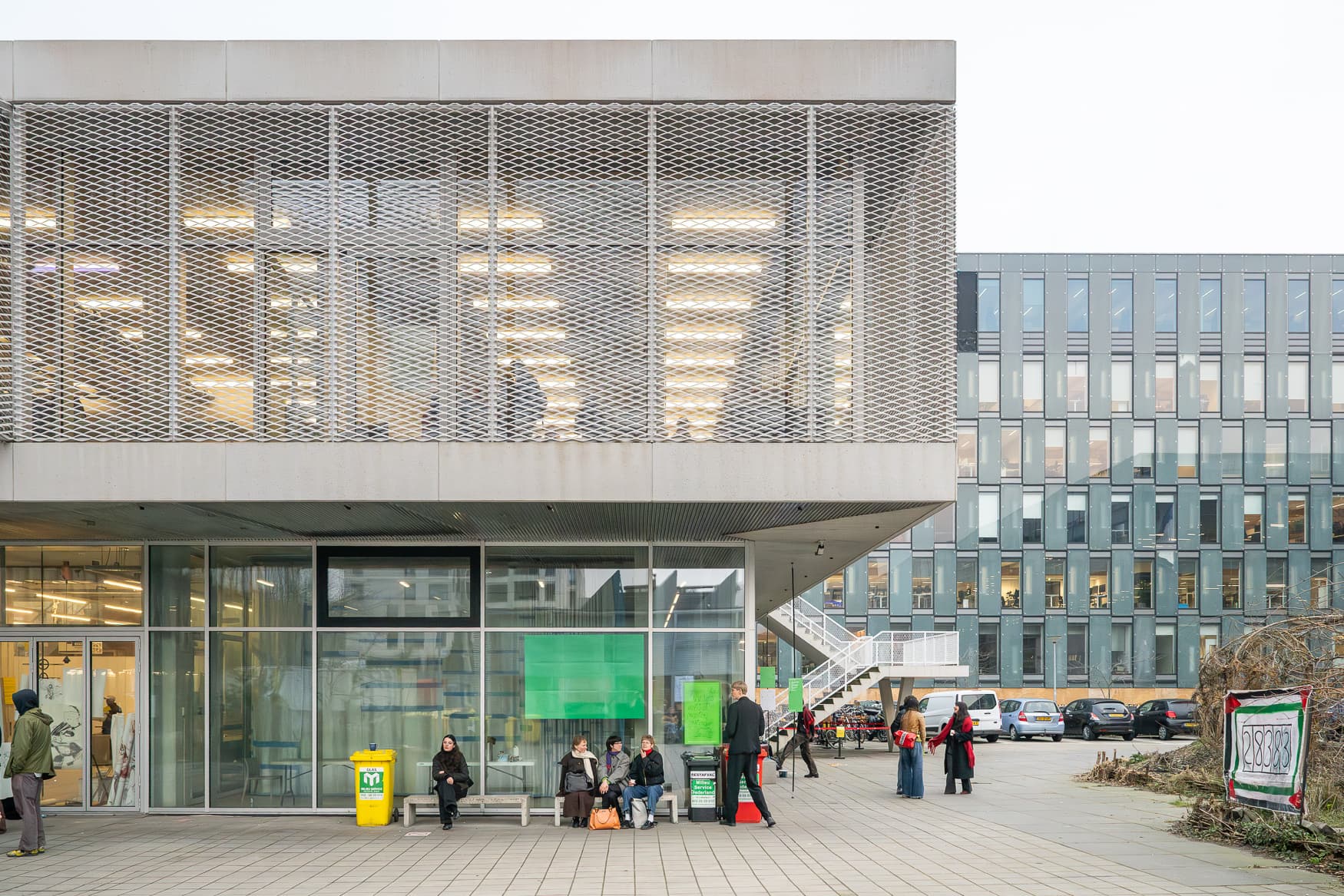
FedLev Building, Open Day 2026. Photo by Sander van Wettum
Accreditation & Degrees
The Gerrit Rietveld Academie's Master Fine Art and Design and Master in Interior Architecture offered by Sandberg Instituut are accredited by the Dutch-Flemish Accreditation Organisation (NVAO). Both programmes have also been awarded the special attribute ‘Small-scale Intensive Education’ (BKKI).
This means that students receive a recognised Master’s degree on successful completion of their studies, they can apply for study financing, and their studies are largely funded by the government. At Sandberg Instituut the departments of Design, Critical Studies, Dirty Art Department, Fine Art and all Temporary Departments lead to the Master of Arts in Fine Art and Design (MA). The department Studio for Immediate Spaces leads to a Master in Interior Architecture (MA).
Every six years, a re-accreditation takes place to examine whether each programme (still) meets the quality requirements. An independent panel, consisting of members who have knowledge of the field and of education, visits the academy for this purpose. They talk to various sections of the academy including students and alumni about, among other things, the objective of the study programme, the design of the education, the tutors, the facilities, the quality policy, assessment criteria and processes, and the learning results achieved. Before visiting, the panel reads the self-evaluation written by the programme.
Based on the positive panel report, the NVAO concluded on 26 January 2026 to re-accredit the Master in Fine Art and Design programme and to extend the special quality feature of Small-scale Intensive Education. The next accreditation will take place in 2031.
Based on the positive panel report, the NVAO concluded on 24 April 2023 to re-accredit the Master in Interior Architecture programme and to extend the special quality feature of Small-scale Intensive Education. The next accreditation will take place in 2027.
The reports are made public by the NVAO and can be found here:
– NVAO’s decision on the accreditation of the Master programme in Fine Art and Design (please note this document is only available in Dutch)
– Panel report on the quality of the MA programme in Fine Art and Design
– NVAO’s decision on the accreditation of the Master programme in Interior Architecture (please note this document is only available in Dutch)
– Panel report on the quality of the MA programme in Interior Architecture
Duration of studies
All departments offer full time two-year curricula for a total of 120 EC's. Students earn 60 EC's per year (European Credit Transfer System).
Language requirements
All courses at Sandberg Instituut are taught in English, and some communication in Dutch. But as a foreign student, learning Dutch is not compulsory. During the interview, as a part of the admission process, your English language level will be evaluated. If there is doubt we will ask for proof that English can be regarded as your mother tongue (passport) or that you have followed English in secondary/high school with a positive mark on your diploma.
Pre-education requirements
We can only accept you as a student if you have a valid Bachelor's degree in a field relevant to the programme you are applying for. We will ask for a copy of your diploma after you have been accepted as a student. If you are unable to provide any diplomas, please indicate so in Step 1 of the application process, on the digital registration form. In that case we will evaluate your pre-education as well as your professional experience.
Grants and Financial aid
Dutch students are sometimes eligible for funding. In practice hardly any students receive a study loan or grant, and they combine their studies with a (side) job. (only for European students).
Unfortunately, Sandberg Instituut cannot provide financial aid for students. International students are advised to try to obtain a grant in their country of origin. Please also see Nuffic's grant finder tool.
We cannot provide letters of approval beforehand; you need to apply and be accepted first. If this means you need your application results at an earlier date, please contact Sandberg Instituut staff in time.
NL Scholarship for Non-EU students
Gerrit Rietveld Academie can award a total of five NL Scholarships (formerly known as 'Holland Scholarship') of €5,000 to non-EU students who will be studying in Higher Education in the Netherlands for the first time.
Of these scholarships, three are available for Bachelor students and two for Master students. For more information see here.
During the application procedure for Rietveld Academie/Sandberg Instituut, candidates will receive an email with an application form.
Candidates who are not eligible for this scholarship program will have to apply for a scholarship themselves (in their home country).
Visa (MVV)
Students in the Netherlands must have a legal status. Citizens of the following countries are exempt from MVV visa requirements:
All EU/EEA countries; Austria, Belgium, Bulgaria, Cyprus, Czech Republic, Croatia, Denmark, Estonia, Finland, France, Germany, Greece, Hungary, Iceland, Ireland, Italy, Latvia, Lichtenstein, Lithuania, Luxembourg, Malta, Norway, Poland, Romania, Portugal, Slovakia, Slovenia, Spain, Sweden, Switzerland, Australia, Canada, Japan, New Zealand, South Korea, United States.
Students from any other country are required to obtain a MVV visa. As soon as you pass the selection procedure you will be informed on how to obtain a visa.
Please note: A student of this category will be asked by the IND (visa issuing Government Organization) to proof there is an amount of at least €22,143 in their bank account.
Housing
It is becoming increasingly difficult to find housing in Amsterdam. Because the housing situation is so precarious, we suggest that successful applicants treat their process of house-searching with the utmost urgency. Please give yourself as much time as possible to search for a home. As a suggestion, one could start by subscribing to StudentenWoningWeb. It is also suggested to keep an eye on the Sandberg Instituut Facebook group and the Gerrit Rietveld Academie Facebook group (which tends to be more active).
Sandberg Instituut offers a limited amount of accommodation at Jacques Veltmanstraat for new, international, full-time students who come from non-European countries through student housing organisation DUWO. All studios and apartments are self-contained and furnished. The accommodation is available for a maximum of 2 years, as long as you are a registered student.
Missed our Open Day this year?
Financial Information
The tuition fees for 2026–2027 are:
- €3245,00 for EU/EEA students without a Dutch master's degree
- €9816,00 for all students who followed a masters programme in the Netherlands and obtained a Dutch master's degree
- € 9816,00 for non-EU/EEA students
If you are unsure what applies to you click this link
*Exception: students with a Swiss or Surinamese nationality, or with a specific type of residence permit are treated as EU/EEA
*Applicants from the United Kingdom are considered non-EU/EEA
The tuition fee must be paid in one amount before September 1.
Cost of Living
In addition to the tuition fee, please take into account the costs below. The eventual costs vary depending on your personal situation and individual choices. Nevertheless, it's advised to count on at least €1,500 living expenses per month:
- Rent €700-950
- Energy bill €200
- Internet €25
- Water €15
- Health insurance €150
- Phone bill €50
- Home & liability insurance €15
- Groceries €200–250
- Study material & excursions €100
- Public transport €75
- Leisure & personal care:
- Gym €50
- Parties, drinks €100
- Various (bike, hair) €150
- Cinema member €20